
Volume 2, No. 1
Our editor sat down with Los Angeles artist, Eunice Lee, to talk about breaking free from expectations and finding the beauty in the mess.

Brooke: Hi Eunice. I just want to say I really love your work and have been admiring it from afar on your Instagram page. I’d love to hear how your journey as an artist began. How did you first become interested in art? Did you always paint, or have you dabbled in other mediums?
Eunice: That’s so kind of you, Brooke. As a kid, I always enjoyed art. I would always be doodling and drawing and crafting. However, I didn’t see it as a viable career option because my dad discouraged me from it. Therefore, in middle school through college, I focused more on academics and “practical” subjects. Eventually, I got an M.Div, which, while it wasn’t practical, was familiar since my father was a pastor himself. In seminary, one of my professors gave us an unconventional option for our final project: we could either submit a traditional paper or choose to complete some type of artwork, like a painting. This was a no-brainer for me, and I was shocked to see that some of my classmates preferred the paper! (Haha!) That’s when the seed was planted for painting specifically. However, it wasn’t until after I burned out in ministry, I reopened myself to creative pursuits beyond a hobby. A friend introduced me to hand lettering thinking it was right up my alley because people had always marveled at my handwriting. While I eventually came to see that this was not the right medium for me, it was a gateway back to my artistic self.
Brooke: How has your art evolved since you first started? I remember meeting you a couple of years ago at a women’s conference, and you shared how you were learning to really have fun, instead of focusing so much on precision like you used to. Can you share a little bit about that?
Eunice: I lived a lot of my youth focusing on performance and meeting external expectations, so despite the fact that I really see art as most impactful when it comes from a place of authenticity, I was having a hard time shifting away from a similar posture of performance and perfectionism. It’s second nature for me to try to project a certain type of image. As an Asian American who grew up in a predominantly white community, I tried to be as “white” and “normal” as possible at school. At my Korean immigrant church, I tried to be a model Christian and “good” according to Korean cultural values as a pastor’s daughter. In a lot of ways, evolving in my art has paralleled my journey of learning how to operate in this world as my genuine self as opposed to a version of myself I think will best fly under the radar. It’s not necessarily drastically different from how I behaved before, but, for example, showing my playful or edgier sides (edgy relative to me since I’m probably still pretty tame compared to a lot of other people), rather than the more responsible, proper, and organized sides of me, previously felt very taboo in some contexts. But I’m trying to let my guard down more, and it’s a lot less tiring to always be “on.” In a similar way, painting in loose, unpolished ways vs. neat and straight felt very exposing; yet, ultimately, it felt more true to myself and I was happier with the results.
Brooke: Can you walk us through your creative process from concept to completion? I’d love to know what inspires one of your paintings and how you translate that inspiration onto a canvas.
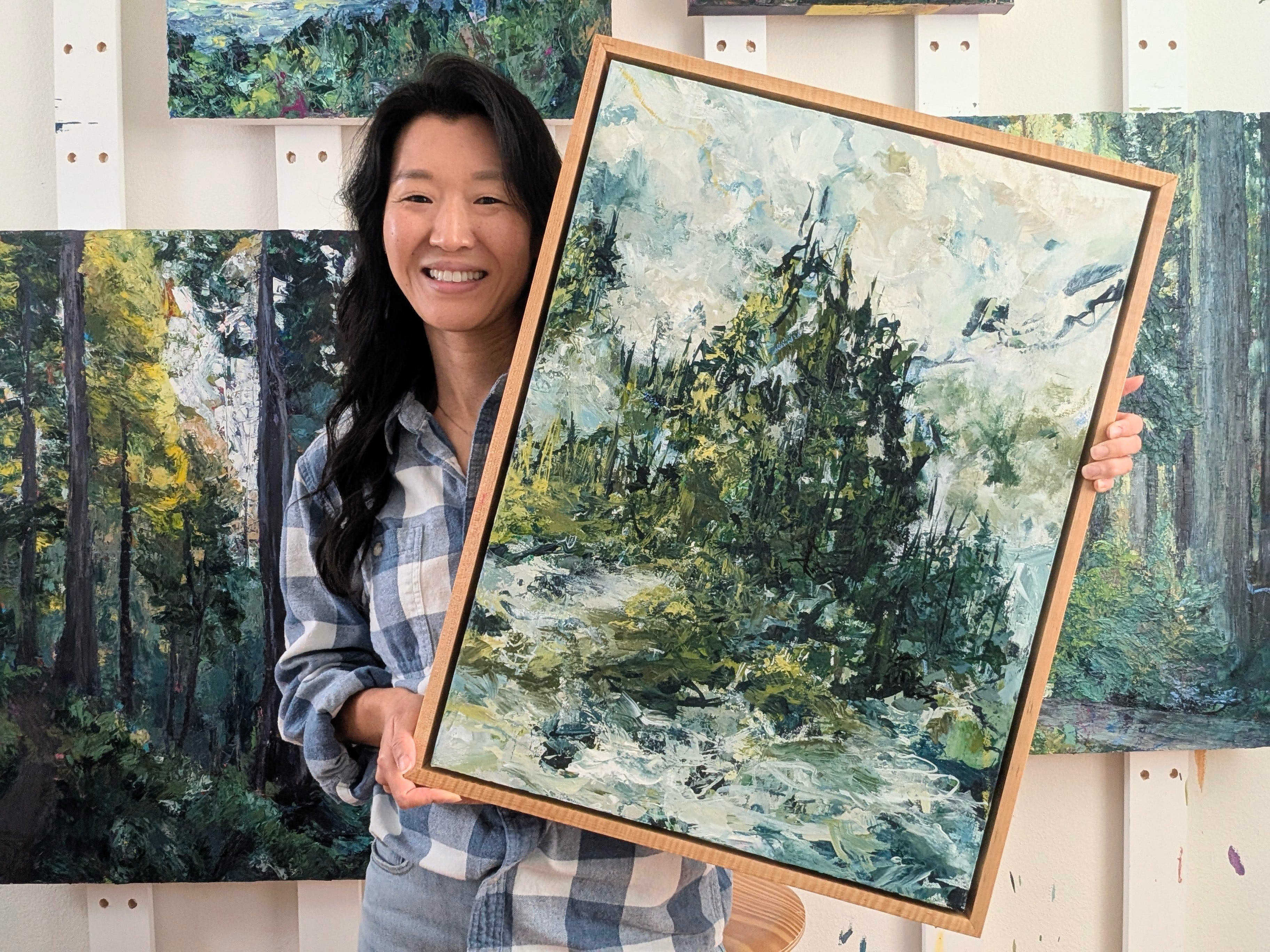
Eunice: Honestly, it took me a long time to understand my own process and also accept my process as my process because it didn’t necessarily look like other people’s. I am definitely drawn more towards painting nature, so when I’m out and about, there might be a nature scene that catches my eye. I will then take a photo of it, doing my best to compose it from the get-go. Later, I’ll review the photos and select the ones that seem to call to me to be painted. I’ll contemplate what about that scene grabbed me and consider what size and dimension of canvas fits what it seems to want to say. I know that all sounds vague, but I guess my inspiration is just an inner, non-verbal pull that I follow and see where it leads.
When I start a painting, I will throw all sorts of different colors onto the canvas to cover up the white. At this point, I’m not thinking at all. I might mix a few colors, or I just use the paint straight out of the tube and mix it right on the canvas. Once that first layer dries, I like to go in and scribble with oil pastels. I love the visual texture, gradient, vibrant color that the oil pastels add. Most of this under layer will then be covered up with the “ actual” painting, but it guides the painting’s color palette and some of it will still peek out at the end. I love the surprising, organic textures this allows me to retain. They are hard to replicate in subsequent layers when I’m being more intentional. If the subsequent layers become too tight, however, I might walk it back in a similar fashion by scribbling all over the canvas again with the pastels or paint to refresh it and allow me to reset.
In this way, I’d say my process is more cyclical than linear—or even like walking a labyrinth. I’m circling around my aim, sometimes moving closer, sometimes moving farther, searching. As I’m painting, I’m seeking and experimenting, applying paint here, trying that color there, taking a step back and evaluating how it feels, leaning in or pivoting as needed. I know there’s something inside of me that longs to be expressed, but I’m not completely sure how to capture that or even what it is. I’d say I’m more successful at achieving my goal than at other times. Sometimes (often?) I fail, and I’m learning what to do with that.
Brooke: I noticed that some of your paintings are more abstract than others. Do you have a particular artistic style that you prefer? What would you call your specific artistic style?
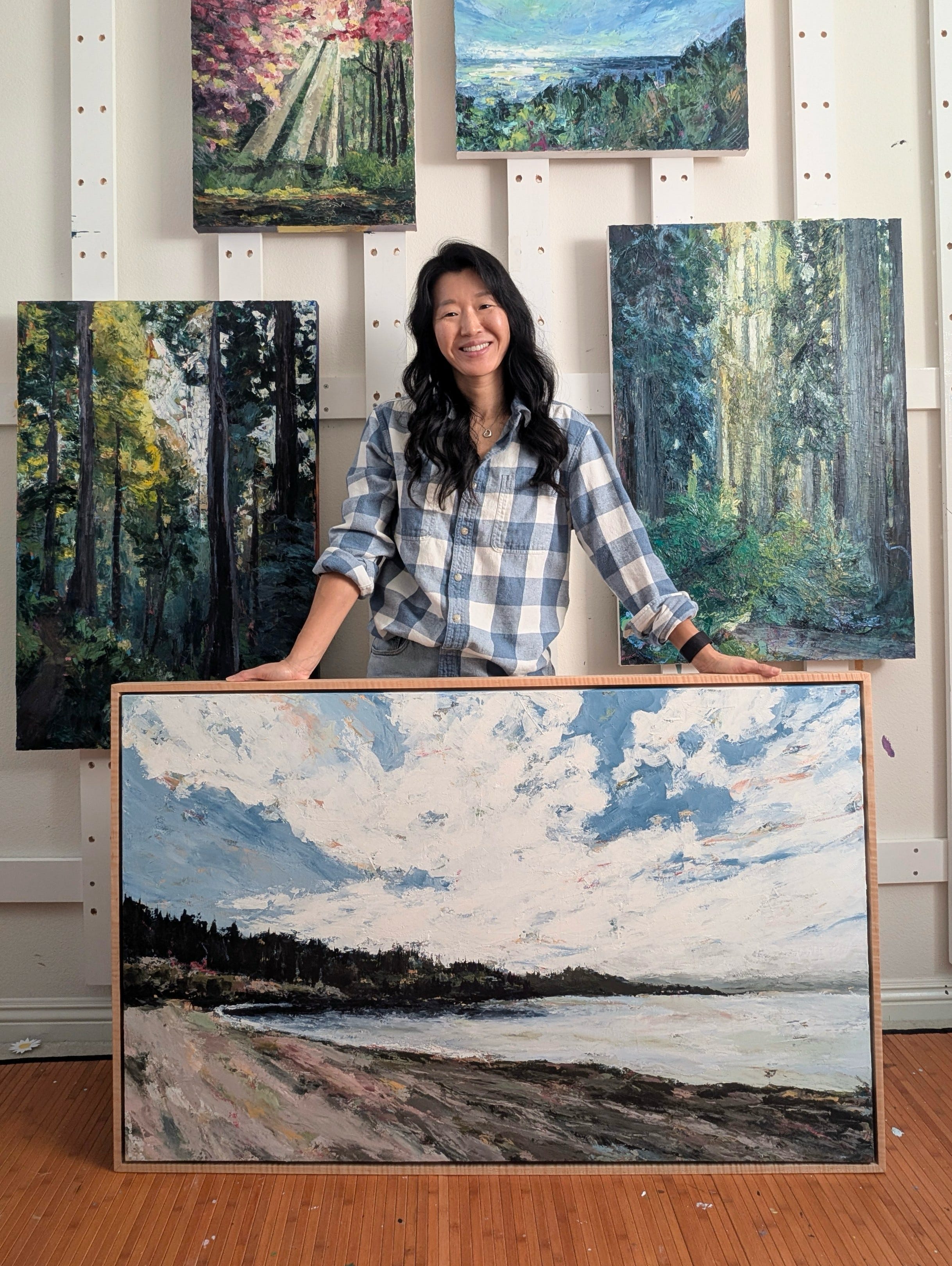
Eunice: I definitely prefer a semi-abstract style. Honestly, it’s easier to paint realistically and I can get pulled into technicalities so quickly, but I don’t like it when my paintings become too realistic. I crave texture and movement in them. Yet, while I like abstract paintings, if I go full abstract, I find myself wanting some concrete anchoring of what I’m actually painting. I want to capture the way a place makes me feel deep within, but it seems like I want it to be recognizable and understood to an extent. I appreciate the aesthetics of form, but it doesn’t have to look exactly like what I’m painting; it could just be inspired or implied. I think that’s part of the searching I mentioned earlier. I’m always trying to find my happy balance between calming structure and liberating wildness, between the beauty of form and the relief of imperfection.
Brooke: Yeah. I have a lot of those same feelings when I view your work. They are very atmospheric. So tell me this, what themes or messages do you often convey in your artwork? Does personal experience or your faith influence your art at all? Is there a specific piece that feels more personal to you? Can you tell us about that?
Eunice: At a most basic level, I paint nature because it makes me happy. I feel such a spiritual connection to the Creator/ the Divine through nature, and I also love imbibing nature’s full and paradoxically still aliveness within the parameters of being itself. I just took a road trip passing through the Redwood National Forests, and the depth of peace and profound sense of something greater than myself was so grounding and enlivening. I would love to be able to translate that sense through my paintings.
At a more implicit level, my process of creating my artwork is its own message: the value of being true to yourself, the normalization of process (we will all have our beautiful, ugly, good, and messy stages), allowing yourself the freedom to make mistakes and try new things, approaching life with curiosity as opposed to fear, and not attaching your worth to failure.
Brooke: I absolutely love that! Tell us some of the biggest challenges you’ve faced as an artist. How did you overcome them? How do you handle creative blocks? What about negative feedback from critics? What advice do you have to other artists who face similar challenges? Blah. I know that is a lot of questions.
Eunice: In the beginning, I had a lot of moments when I would encounter frustrations where a painting would not come together, and it looked and felt awful to me. Whenever that would happen, I would spiral and believe I was a terrible artist and that I should just quit. Self-doubt is probably my biggest challenge. However, what I discovered was that these emotions would pass, and it’s just about showing up and trying again. The only way to find what you’re seeking is to wander and wonder. Sometimes that means stepping away and experimenting and playing on something else, letting a painting rest, and then coming back when I’m in a more playful, less pressured frame of mind. These moments of frustration or confusion about where or what I was trying to do were all part of the process. And while there are so many ways I can improve as an artist, the only way to get better is to try again and put in the work (and play!). Seeing these blocks in this way was a much more compassionate and spacious way to treat myself—and more grounded in reality!
Honestly, I don’t think I’m well-known enough to have received much negative feedback. I think at most I can tell sometimes when a painting is not to a person’s personal taste, which I am completely fine with. I actually appreciate honest feedback as well. I would rather hear someone’s genuine reaction to a painting than to receive empty or polite praise. I want to know if my painting is evoking the kind of emotions that I’m aiming for or any emotions that can contribute to the conversation, and when someone’s reaction to a painting aligns with that, that is the ultimate joy! And if someone gives me negative feedback that is irrelevant to my objective, then it really doesn’t matter much to me and is pretty easy to shrug off.
As far as advice goes, I’d say it’s important to understand your own values and your own why to keep you rooted through the ups and downs and nay-sayers – even when that nay-sayer is in your own head! I also think having a circle of supporters who understand what you’re trying to do and know you is helpful. You don’t need everyone’s approval, and it’s important to know which voices to let in and which ones to simply let roll off your shoulder. But at the end of the day, it’s important to cultivate and strengthen your own voice and know what you are happy with.
Brooke: Is there a painting or exhibit that you are most proud of? Do you have any upcoming shows or exhibitions that you’re excited about? Or perhaps a project you’re working on that you have high hopes for? Where do you see your art taking you over the next few years?
Eunice: Currently, I am transitioning from acrylics to oil paints, so that’s been a learning curve and preoccupying my focus. I mentioned my trip through the Redwood National Forests, and after that, I feel like all I want to paint for the rest of my life is forests (lol). We’ll see how long that lasts, but I’m realizing I’m very much a forest girl, and as much as I love the ocean and mountains, nothing makes me feel the way the woods do. So I’m both enjoying the challenge of learning the ins and outs of oils and excited about this series where I’ll be trying to capture the life-giving beauty of the Redwoods on canvas.
I’m often pondering what I want for my art and what it looks like to move beyond the privacy and sanctuary of my studio into community. Honestly, I have more questions than answers right now. But something I often consider is doing some painting workshops. I think that art is such a powerful tool for de-stressing and connecting with yourself. I don’t want to teach art per se but want to provide a space where people can let loose and express themselves and in so doing, maybe experience what I have through art: the freedom to be themselves. I have a lot of thoughts and ideas, but I’m also admittedly a slow mover. A five-year plan for others is probably more like a 20-year plan for me. Haha.
Brooke: Oh, I’d love to take one of those workshops! Please let us know when you plan to do that. Where can we locate you online to check out some more of your work? Instagram, a website, for example. If we wanted to purchase one of your paintings, how do we go about doing that?
Eunice:
I do have an Instagram and a website. Admittedly, I haven’t updated these sites with my latest work because I’d much rather be experimenting with my oil paints, but I’m working on it. My Instagram handle is @by_eunicelee, and my website is www.byeunicelee.com. Original paintings, commissions, and prints are available through my website.
 | A guest post by
|